How Long Does It Take to Frame a Two-Story House in Canada? (3 Methods Compared)
If you're planning to build a two-story single-family home in a Canadian suburb, one of the first scheduling questions you'll run into is:
How long will the framing take?
Framing speed matters—a lot. It affects not only how fast the project dries in, but also when trades like plumbing, electrical, and HVAC can start.
In this post, we’ll compare the framing timelines for a typical 2,000 sq. ft. home (about 1,000 sq. ft. per floor) using three common construction methods:
1. FRAMECAD prefabricated light-gauge steel panels
2. Traditional steel stud-and-track (site-built) framing
3. Traditional wood framing
Let’s break down how long each method usually takes, why it takes that long, and what pros and cons you should expect.
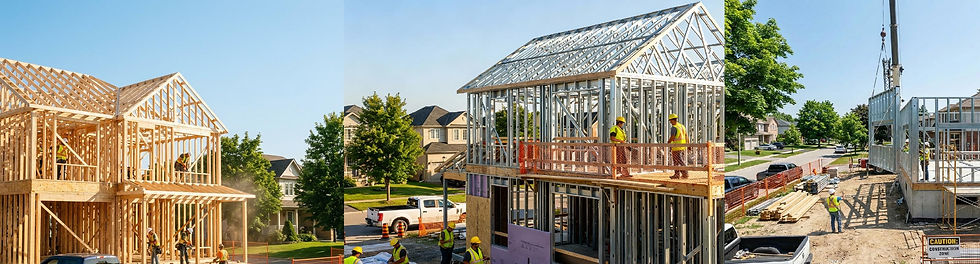
1) FRAMECAD Prefabricated Steel Panels
Estimated framing time: 5–10 days
FRAMECAD is a computer-driven fabrication system that produces precision-cut steel panels off-site. These arrive ready to assemble, almost like a giant Meccano kit for builders.
Why it’s the fastest option
Panels are pre-engineered and pre-assembled, so there’s little cutting or layout work onsite
Smaller crews are needed (3–5 people are often enough)
Less material handling and lower chance of errors or rework
Minimal waste and very consistent quality
Typical build timeline
Days 1–2: First-floor wall panels go up
Days 3–4: Floor system and second-floor structure
Days 5–7: Second-floor wall panels
Days 7–10: Roof trusses/panels and bracing
For speed, precision, and predictability, it’s hard to beat the FRAMECAD approach.
2) Traditional Steel Stud & Track (Site-Built)
Estimated framing time: 3–5 weeks
This method uses light-gauge steel studs and tracks but requires crews to measure, cut, drill, and assemble everything onsite. It’s more labor-intensive than prefabricated steel and often slower than wood.
Why it takes longer
All studs, tracks, and headers are fabricated on location
Steel requires more fasteners and alignment checks than wood
More technical skill is required for clean, plumb, and square assemblies
Onsite delays add up faster because efficiency depends heavily on crew experience
Typical build timeline
1–2 weeks per floor for walls + floor system
1 additional week for roof framing and bracing
Builders choose this option mainly for durability, fire resistance, and dimensional stability—but it demands more time on the jobsite.
3) Traditional Wood Framing
Estimated framing time: 2–4 weeks
Wood framing remains the most common method in Canada, thanks to a large skilled labour pool and relatively low material costs.
Why wood is mid-range in speed
Crews are usually larger and very experienced
Wood is easy to cut, adjust, and assemble onsite
Prefabricated roof trusses can significantly shorten the roof phase
Material availability is high, reducing downtime
Typical build timeline
5–10 days per floor for walls + floor system
3–7 days for roof trusses and sheathing
Overall, wood framing is efficient, flexible, and cost-effective—though it’s more vulnerable to moisture and has shorter long-term dimensional stability than steel.
Side-by-Side Comparison
Framing Method | Typical Timeline | Crew Size | Key Advantages | Key Drawbacks | Cost Notes |
FRAMECAD Prefabricated Steel Panels | 5–10 days | 3–5 | Fastest; precise; minimal waste; consistent quality | Higher factory-production cost; shipping logistics | Can be cost-competitive when onsite labor costs are low, since most work is done offsite. |
Traditional Steel Stud & Track | 3–5 weeks | Medium | Durable; non-combustible; dimensionally stable | Slower; labor-intensive; requires more skilled labor | Labor costs can be high due to onsite fabrication time. |
Traditional Wood Framing | 2–4 weeks | Larger | Cost-effective; readily available materials and crews; fast with experienced framers | Vulnerable to moisture, rot, and warping; less long-term precision | Typically lowest material cost; labor efficient due to large workforce availability. |
Which Method Should You Choose?
Choosing the right framing method depends on your priorities—speed, cost, labor availability, and long-term performance. Here’s how to think about it based on the updated comparison:
If speed and precision are top priorities:
Go with FRAMECAD prefabricated steel panels.
They offer the fastest erection time and extremely consistent quality. Although they typically have higher factory-production costs, they can become highly cost-competitive when onsite labor costs are low, because much of the work is shifted offsite to automated manufacturing.
If long-term durability and fire resistance matter most:
Choose traditional steel stud & track framing.
It’s slower and more labor-intensive, but gives you excellent dimensional stability and non-combustible construction. This approach is often chosen for durability-focused builds or where fire ratings are critical.
If you want the most economical and widely supported method:
Traditional wood framing is typically the most cost-effective option in Canada due to inexpensive materials and a large pool of experienced crews. It balances speed and price well, though it’s more vulnerable to moisture and long-term movement than steel-based systems.


