Integrated Software and Machines Are Revolutionizing Cold-Formed Steel Construction
Updated: May 17
The construction industry is under constant pressure to deliver projects faster, smarter, and more cost-effectively—without sacrificing quality. One innovation that is transforming the way buildings are constructed is integrated software and machine systems for pre-engineered cold-formed steel (CFS) framing.
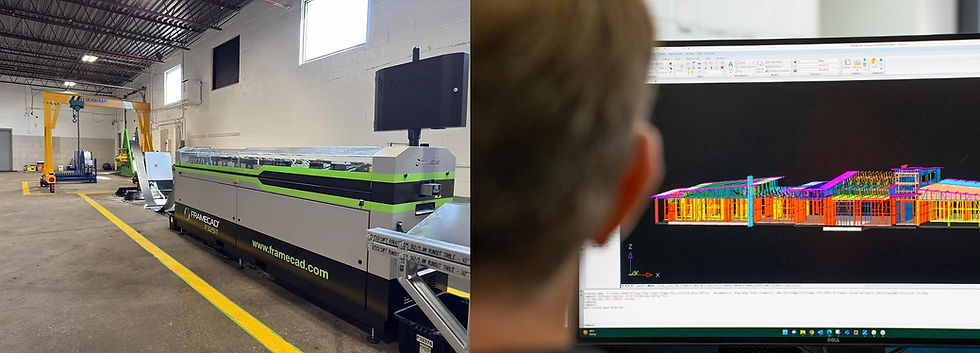
By combining design software, engineering intelligence, and automated fabrication machines into a seamless workflow, construction projects benefit at every stage—from planning to installation. Here’s how this technology is changing the game.
1. End-to-End Digital Workflow Minimizes Errors
Traditional construction workflows involve multiple handoffs: designers create drawings, engineers reinterpret them, fabricators translate them again, and installers adjust on-site. Each handoff introduces potential errors.
Integrated CFS systems eliminate these gaps by creating a single digital source of truth:
Designs are generated in intelligent 3D modeling software
Engineering checks are built into the system
Manufacturing data is directly exported to automated machines
Components are produced exactly as designed
This integration drastically reduces errors and ensures high accuracy and consistency.
2. Faster Project Delivery
Time is critical in construction, and integrated CFS systems accelerate every stage:
Designs can be finalized quickly and updated in real-time
Manufacturing begins immediately after approval
Components arrive on-site pre-cut, labeled, and ready to assemble
This enables parallel workflows, where site preparation and framing production happen simultaneously, shortening overall project timelines.
3. Precision Manufacturing for Higher Quality
Automated machines produce steel components with millimeter-level accuracy. Each stud, track, and truss is:
Cut to exact length
Pre-punched for services
Clearly labeled for assembly
The result is perfectly aligned structures, better structural performance, and reduced on-site adjustments.
4. Reduced Waste and Lower Costs
Integrated CFS systems optimize material usage. The software calculates precise requirements, minimizing excess steel and off-cuts. Benefits include:
Less material waste
Fewer errors requiring rework
Lower storage and transport costs
Over the life of a project, this leads to significant cost savings.
5. Safer and More Efficient Construction Sites
Off-site fabrication means:
Less cutting and welding on-site
Fewer tools and operations
Faster, more predictable installation
Crews can focus on assembly rather than improvising, creating a safer and more productive job site.
6. Scalability and Design Flexibility
Integrated CFS systems work for both small and large projects. Design changes are:
Updated digitally
Automatically re-engineered
Manufactured with minimal delay
This allows rapid customization without slowing production, ideal for projects that require repetition, modularity, or frequent revisions.
7. Better Coordination with Other Trades
Modern CFS software integrates with BIM and other digital construction workflows, allowing smoother collaboration between:
Structural systems
MEP installations
Architectural elements
Pre-punched service holes and clash-free designs reduce surprises on-site and improve coordination across all trades.
Conclusion
Integrated software and machines for pre-engineered cold-formed steel framing are redefining construction standards. By linking design, engineering, and fabrication into one cohesive workflow, projects benefit from:
Faster delivery
Higher accuracy
Reduced waste
Lower costs
Safer and more efficient sites
For any construction project aiming for speed, quality, and efficiency, this approach represents the future of building smarter.


