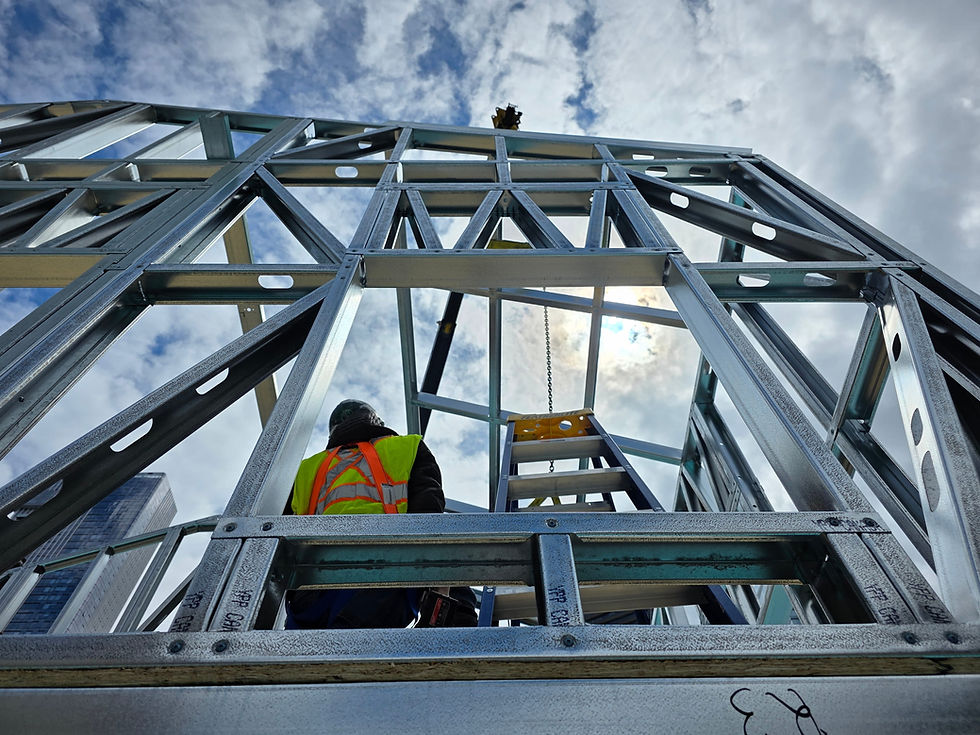
Cold-Formed Steel Framing in the National Building Code of Canada
Cold-formed steel (CFS) framing plays a vital role in Canadian construction, and its regulation is firmly anchored in the National Building Code of Canada (NBCC). This code relies on key standards such as CSA S136, a harmonized North American specification, to ensure proper structural design and installation. Additionally, the Canadian Sheet Steel Building Institute (CSSBI) supports compliance through a wealth of technical resources, including design guides, technical bulletins, and certification programs. Together, these elements ensure that CFS framing meets the performance requirements of Canadian construction projects.

Navigating the Core Components of the Code
1. National Building Code of Canada (NBCC):
As the backbone of building regulations across Canada, the NBCC provides comprehensive guidelines for structural design. It includes specific provisions for cold-formed steel construction methods, ensuring safety and reliability throughout the building lifecycle.
2. CSA S136:
This essential specification forms the technical foundation for CFS design in Canada. Covering everything from material properties to engineering principles, CSA S136 ensures consistency and compatibility with the structural demands outlined in the NBCC.
3. ASTM Standards:
The materials used in CFS framing must adhere to recognized standards, such as ASTM A653/A653M, which define quality for sheet steel used in fabricating steel members.
4. AISI Standards:
The American Iron and Steel Institute (AISI) contributes to a unified approach by developing design standards—including S100 and S200—that influence CSA S136. This harmonization helps establish consistent principles for cold-formed steel construction across North America.
Industry Resources to Support Implementation
Canada's CFS industry benefits significantly from resources provided by the Canadian Sheet Steel Building Institute (CSSBI). These tools facilitate compliance with national codes and foster best practices across construction projects:
Technical Bulletins: Featuring insights on critical topics like fire resistance, sound insulation, and material certification, these bulletins help builders and engineers address specific code requirements effectively.
Manufacturer Certification: CSSBI manages a certification program that verifies Canadian-manufactured CFS members align with NBCC standards, supporting industry-wide consistency and quality assurance.
Design Guides: Comprehensive resources such as the CSSBI Guide for Cold-Formed Steel Framing offer detailed instructions for engineers, focusing on structural integrity, thermal efficiency, and acoustic performance.
How These Components Work Together?
To ensure an integrated approach to CFS framing in Canada, various entities and standards operate in harmony:
1. NBCC Establishes the Framework:
The NBCC sets performance benchmarks and ensures alignment with recognized standards for all structural elements, including cold-formed steel components.
2. CSA S136 Defines Design Rules:
Engineers rely on CSA S136’s formulas and principles during structural design to achieve safe and dependable cold-formed steel applications.
3. Industry Tools Enhance Practical Application:
Organizations like the CSSBI provide vital resources and certifications that translate NBCC and CSA S136 requirements into actionable plans for real-world construction projects.
In essence, cold-formed steel framing is more than just a construction material—it represents an intricate system governed by rigorous codes and supported by a network of industry experts. From harmonized international standards to tailored technical guidance, each layer works together to uphold quality, safety, and efficiency in Canadian construction.